

For a long time, sustainable fashion was associated with rough fabrics, neutral colors, and sacrificing style for the sake of ecology. This perception no longer reflects reality. Sustainable women's fashion in Bulgaria emphasizes eco-materials, local production, and ethical practices, while offering garments that look and feel luxurious. For women between 20 and 45 who value quality and style, sustainable fashion is not a compromise. It is the new standard.
Table of Contents
- What Sustainable Women's Fashion Means and Why It's Important
- The Bulgarian Market and Trends: Data, Regulations, and Environmental Challenges
- Luxury and Sustainable Brands: Examples and Bulgarian Successes
- Mechanisms of Sustainable Fashion: Technologies, Certifications, and Policies
- Environmental Impact and Social Responsibility
- Practice: How to Choose Sustainable and Elegant Women's Clothing
- Connect Style and Sustainability: Discover Elegant Solutions at Mythos
- Frequently Asked Questions about Sustainable Women's Fashion
Key Takeaways
| Point | Details |
|---|---|
| Contemporary Style Standard | Sustainable women's fashion is now a symbol of elegance, quality, and social responsibility. |
| Market and Ecology Data | The Bulgarian market is adapting to ecological trends, and regulations are guiding the industry toward sustainability. |
| Practical Choices for Women | Choose clothes with eco-certificates and local production – this ensures style, quality, and environmental friendliness. |
| Impact on Society and Environment | Sustainable fashion reduces negative footprint and supports fair labor practices. |
What Sustainable Women's Fashion Means and Why It's Important
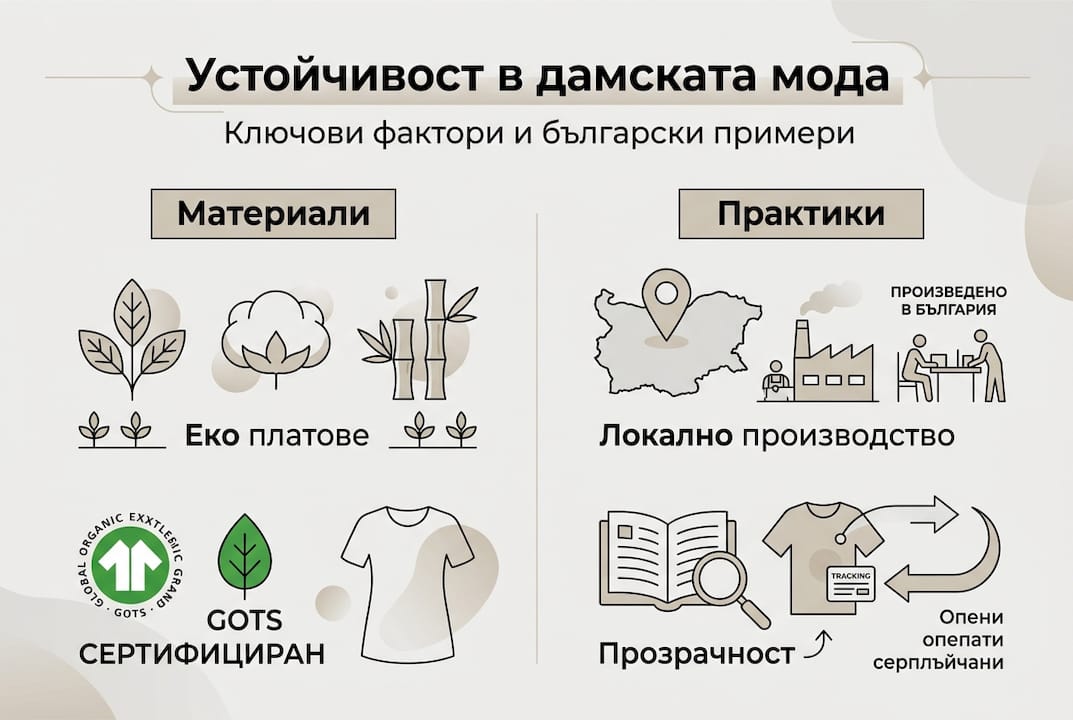
Sustainable fashion is not just a buzzword. It describes a production method where every step of the chain, from raw material to finished product, is conceived with care for people and nature. Organic materials, fair labor conditions, and a minimal environmental footprint are its three pillars.
For the modern woman in Bulgaria, this means concrete benefits:
- More durable clothes with better stitching and fabric quality
- Transparency regarding origin and production conditions
- Guilt-free style with every purchase
- Support for the local economy by choosing local brands
"Sustainable fashion is not a trend that will pass. It is a response to a real problem and a new way to express ourselves through clothing."
Bulgarian brands like Dragonfly and ROSI are already using GOTS-certified materials and local production, proving that elegance and responsibility go hand in hand. If you're looking for inspiration for elegant women's clothing, you'll see that sustainable solutions now take center stage in the modern wardrobe. Understanding these principles is the first step towards a more conscious and stylish choice.
The Bulgarian Market and Trends: Data, Regulations, and Environmental Challenges
Bulgaria is not isolated from global changes in the fashion industry. On the contrary, the market is adapting quickly, and the data confirms it.
| Indicator | Value |
|---|---|
| Women's apparel market (2025) | 889 million USD |
| Textile waste collected (2024) | over 8,000 tons |
| Share of recycled textiles | under 1% |
| Expected growth of the sustainable segment | 12% annually |
According to data for women's fashion in Bulgaria, the market will reach 889 million USD in 2025, and collected textile waste will exceed 8,000 tons in 2024 alone. However, the share of actually recycled textiles remains below 1%. This is a worrying discrepancy between the amount of waste and the capacity for its processing.
Important fact: The European Union already requires separate collection of textiles from 2025, which directly affects Bulgaria. This is not just an administrative requirement, but a signal for the entire industry to reorient itself.
For consumers, this means that choosing Bulgarian clothing brands with sustainable practices is no longer just a personal choice, but participation in a larger change. The market is moving in this direction, and women who understand this early will be a step ahead.
Luxury and Sustainable Brands: Examples and Bulgarian Successes
Which brands prove that luxury and sustainability are not mutually exclusive? In Bulgaria, we have concrete examples that deserve attention.

| Brand | Distinguishing Feature | Certification |
|---|---|---|
| ROSI | Local production, avant-garde design | GOTS |
| Albena Gateva | Spiritual luxury, SS26 collection | Ethical practices |
| Dragonfly | Organic materials, minimalist style | GOTS |
| Jane Lushka | European design, sustainable fabrics | LWG |
Brands like ROSI, Albena Gateva, Dragonfly, and Jane Lushka offer elegant and sustainable clothing that successfully competes with international names. How do you recognize a truly sustainable brand?
- Check if the brand publishes information about its suppliers
- Look for certifications like GOTS or LWG on the label or website
- See if production is local or at least regional
- Check if the brand has a policy for returning and recycling old clothes
- Pay attention to the quality of stitching and fabric during physical inspection
Professional tip: When shopping online, look for an "About Us" or "Sustainability" section on the brand's website. If such a section is missing, that itself is a signal. Transparency is a key characteristic of any responsible brand.
If you're looking for a specific product, a luxurious satin blouse is an example of how quality material and careful design meet in one piece. Also check out sustainable alternatives for inspiration when building a wardrobe.
Mechanisms of Sustainable Fashion: Technologies, Certifications, and Policies
Behind every sustainable garment lies a system of technologies, standards, and regulations. Understanding them gives you real power as a consumer.
The circular economy in fashion means that materials are used multiple times. Instead of the linear "produce, use, dispose" model, the circular one closes the loop: old clothes are recycled into new fibers, and waste is minimized.
Key certifications you should know:
- GOTS (Global Organic Textile Standard): Guarantees organic origin of fibers and fair labor conditions throughout the chain
- LWG (Leather Working Group): Standard for responsible production of leather goods
- OEKO-TEX: Certifies that the garment does not contain harmful chemicals
- Fair Trade: Focuses on fair pay for workers
The EU is introducing EPR (extended producer responsibility) schemes, separate textile collection from 2025, and eco-modulation for producers. Eco-modulation means that brands that produce more sustainably pay lower fees, while those with a high environmental footprint are taxed more. This is a financial incentive that accelerates change in the industry.
To better understand the advantages of sustainable brands, it's important to know that these regulations are not just bureaucracy. They are a guarantee that the brand you buy from operates by rules that protect both you and nature. Understanding textile regulations gives you an advantage with every purchase.
Environmental Impact and Social Responsibility
The numbers are eloquent and should not be underestimated.
Fashion generates 10% of global CO2 emissions and consumes 93 billion m³ of water annually. This ranks it among the most polluting industries in the world.
But behind the environmental data lies a social problem. A large portion of workers in the fashion industry in developing countries are women, working under unfair conditions. Sustainable fashion directly addresses this issue as well.
What makes sustainable fashion different in a social sense:
- Guarantees fair wages and safe working conditions
- Supports local communities through local production
- Reduces dependence on cheap labor in distant countries
- Gives visibility to women in the production chain
Brands like ROSI and Albena Gateva not only produce beautiful clothes. They demonstrate that fashion's impact on climate is directly linked to women's rights. When you choose a sustainable brand, you support an entire system of values, not just one product. Explore alternatives to fast fashion to see concrete examples of this difference.
Practice: How to Choose Sustainable and Elegant Women's Clothing
Sustainable fashion does not compromise on elegance; it offers new standards of quality. But how do you put this into practice during your next shopping trip?
- Check the label. Look for certifications like GOTS, OEKO-TEX, or Fair Trade. If they're not there, ask the brand directly.
- Examine the origin. Local or regional production usually means stricter quality control and a smaller carbon footprint.
- Evaluate the fabric quality. Touch the fabric. Sustainable materials like organic cotton, linen, or recycled polyester have a characteristic density and softness.
- Avoid "greenwashing." If a brand claims to be sustainable but doesn't provide proof, be skeptical. True sustainability is transparent.
- Invest in staple pieces. A quality jacket or a classic dress from a sustainable brand replaces dozens of cheap alternatives.
- Combine smartly. Sustainable clothes are designed to last and be easily mixed and matched. One piece can work for the office, dinner, and weekend.
Professional tip: Create a "capsule wardrobe" of 10 to 15 sustainable pieces that can be combined with each other. This reduces the need for frequent changes and saves you money in the long run. For style inspiration, see how elegant clothes can also be responsible.
Connect Style and Sustainability: Discover Elegant Solutions at Mythos
You now know how to recognize true sustainability, which brands are trustworthy, and how to build a wardrobe that looks luxurious and feels right. The next step is to find specific pieces that meet these criteria.
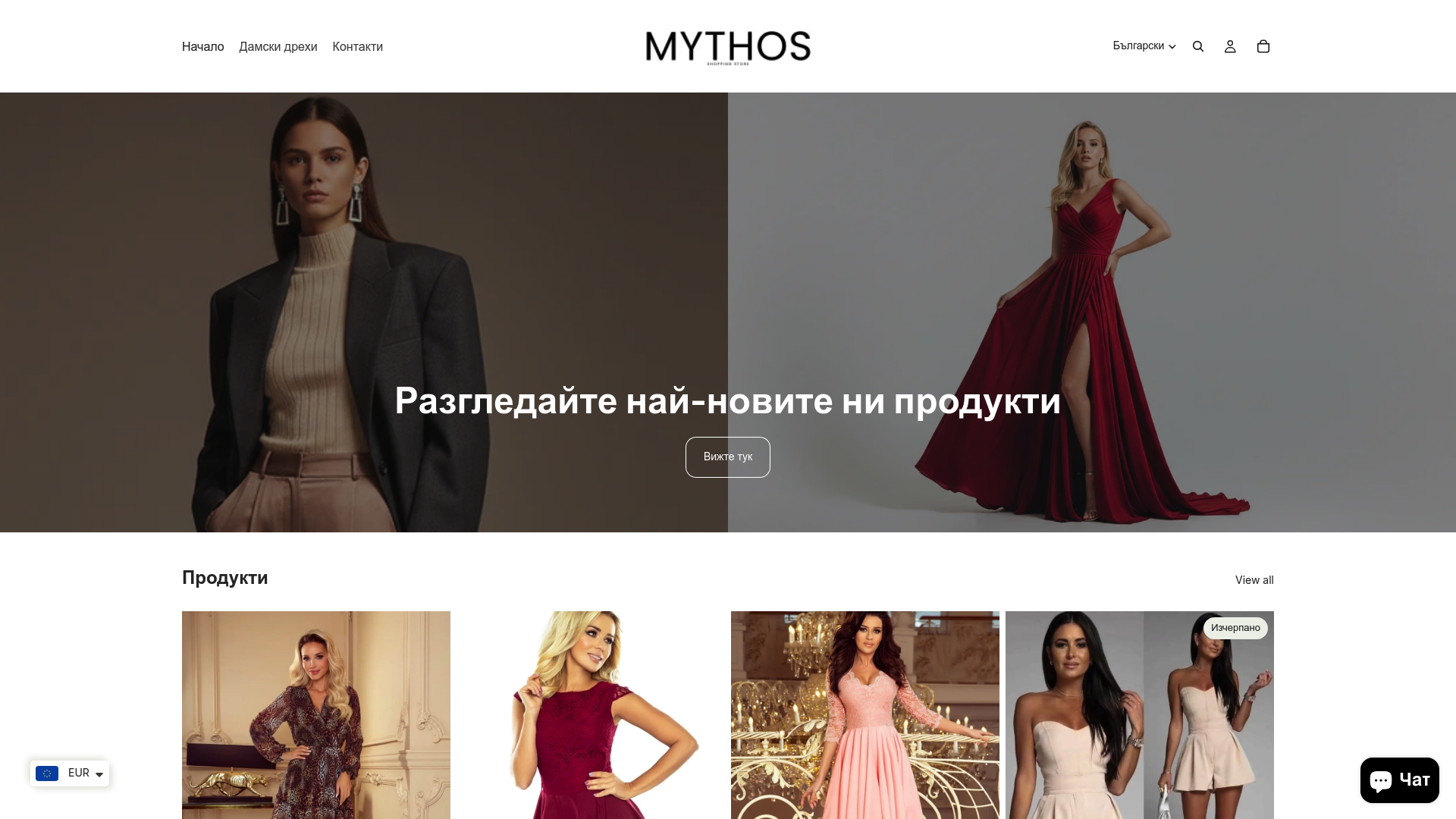
At Mythos.bg, you'll find carefully selected women's clothing that combines modern design with attention to fabric quality. Explore a dress with an impactful print for a special occasion or choose a satin blouse for everyday luxury. All elegant and sustainable solutions are in one place, so you can shop with confidence and style.
Frequently Asked Questions about Sustainable Women's Fashion
What does sustainable women's fashion include?
It includes clothes made from eco-certified materials, local production, and ethical labor practices. The goal is a minimal environmental footprint with maximum quality.
Is sustainable fashion more expensive than fast fashion?
Yes, luxury sustainable brands are typically more expensive, but the investment pays off with a longer garment life and better social responsibility.
How can I tell if a garment is sustainable?
Look for GOTS and LWG certifications on the label or brand's website, along with information about local production and transparent ethical policies.
How big is fashion's impact on the environment?
The fashion industry generates 10% of the world's CO2 emissions and consumes 93 billion cubic meters of water annually, making it one of the most polluting industries.
Are there Bulgarian brands with a global reputation for sustainability?
Yes, ROSI, Dragonfly, and Albena Gateva are recognized for the sustainability and elegance of their products, successfully competing at a European level.
0 comments